For as long as I can remember, science has been the love of my life. Growing up in a single-parent, low-income household, my mom always emphasized
that my education was the greatest asset I could come to posses. She wanted me to go to college and have the future she wasn't able to, to become the first
person in our family to attend a four-year university. I took her advice in stride early on, from joining the chess club to leading an all-female robotics
team to starting a community service project in 7th grade, I eventually fell in love with learning and problem-solving.
I was fortunate to attend magnet programs-- something that many students who are more intelligent than I am are not able to do. In high school, I completed
the AP Capstone program, conducting two meta-analyses on bioimplants used for total hip arthoplasty (one on the biological effects, and one the mechanical
degradation). I learned a few things from that experience:
- Research is incredibly difficult, and incredibly rewarding
- Literature reviews are key to conducting relevant and efficient science, you don't want to repeat what was already done
- Young people with hip implants are going to have a rough time, and that's largely due to the pace at which new technology is adopted (and insurance companies)
- Knowing how to code would have made my life significantly easier
One thing completing a thesis that involves 20+ years of biomechanics calculations will teach you is that you do not want to be the person using a ti84 when
Python, R, Matlab, and everything else exists. So, I enrolled in computer science coursework at NC A&T State University, where my early college is located
(STEM Early College at NC A&T State University).
This felt counterintuitive at first, as little Madison was perpetually obsessed with cells, biology, and chemistry. But if my AP Capstone project taught me
anything, it was that biology as a field is continuously behind the curve. If memorizing information about the human body was going to change the world and
help people like me and my mom, it would've already happened. This expeirence was the first time I had to take a step off of the beaten path to pursue my
goals, and frankly, it was terrifying. What if I ended up being a software engineer? Could I double-major in Biology and CS? And not have a 2.0 GPA? If I
became a scientist instead of a doctor, would I still be able to provide for my family? I didn't know the answer to any of these things, I just knew that I had
found a path too viable to ignore, and that was the path that I was going to follow. For a semester, at least.
Pursuing computer science taught me how to think in systems, algorithms, and data structures. It taught me how to be decisive and precise, to pursue questions
with clear intentions and methods for generating massive amounts of data. The problem then became knowing what to do with it.
When I got to NC State, I was named a Goodnight Scholar, meaning I had four years of funded education, professional development, and a radically supportive
community. I've never experienced anything like it.
For the first time in my life, I didn't have to work every single day to pay for education, food, and housing. I could focus on my studies, and I came to realize
that the work I was trying to do was rooted in empathy for families like mine. And, in appreciating the priviege and opportunity that is my scholarship,
my engineering education, and my ability to pursue a career in public health, I realized that I had a responsibility to use my skills to help others. Thus, I
declared a second major in Science, Technology, and Society. My concentration is in Biomedical Systems, and I've gotten to take some wicked cool classes as a result.
The summer after my first year, I reached out to a peer in the Goodnight program about starting a nonprofit organization. I wanted to find a way to spread STEM education,
and to expose more students to the learning that had transformed by life. I remember typing on a google doc: "nonprofit?" and planning what was first "Collaborative Computing",
and what later became "Students Leading Collaborative Computing Education", aka SLCCE Inc. (which yes, we do have a DBA for).
SLCCE grew faster than anyone could've predicted. From going to begging people to join the eboard for this admittedly ambitious project, to serving nearly 500 students in 2 years
and having a competitive application cycle for the incoming eboard, we've built a community that will outlast our time at NC State. As my co-founder and I continue to work
toward expansion and new chapters, I'll never not be amazed at the work that we've done and that others are continuing in our stead.
SLCCE, by the way, functions by having college students develop workshops in comptuer science and electrical and computer engineering, which we then teach at high schools without
STEM programs. We're able to help college students develop their portfolios while also serving as role models to students. Not random adults coming into their classrooms and telling
them what to do. People who can demystify technology and university at the same time.
At NC State, I stay involved on campus. Of course, I've continued to collect academic accolades, but I'm proud to lead the Grand Challenges Scholars Program as a student lead as well as
by serving as president of the Grand Challenges Student Organization. I took a special interest in this program because any engineering student can join it. At a time where so many universities
(including land-grant institutions like NC State) are focused on accumulating prestige, I can't help but feel like we've lost touch with the original mission of higher educaiton. Was
the goal not to education the masses? To advance the condition of individual memebers of a society?
GCSP provides an opportunity to serve the land-grant mission, by enhancing the programming that is offered to students who may not be part of named programs, who may not have the resources
at home, but who are just as deserving as any other student of an education that equips them to excel in their field. Being part of this program's development has allowed me to create
more opportunites for my peers, and it's shown in my quadroupling of programming events and tripling of student organization events since becoming president my junior year.
The critical role that institutions play in shaping young researchers, as well as every other member of society, became apparent to me during my Fulbright.
(pardon my dust as I work on making this section more personable!)
- fulbright (institutions, sense of self)
- truman
- faculty senior scholar
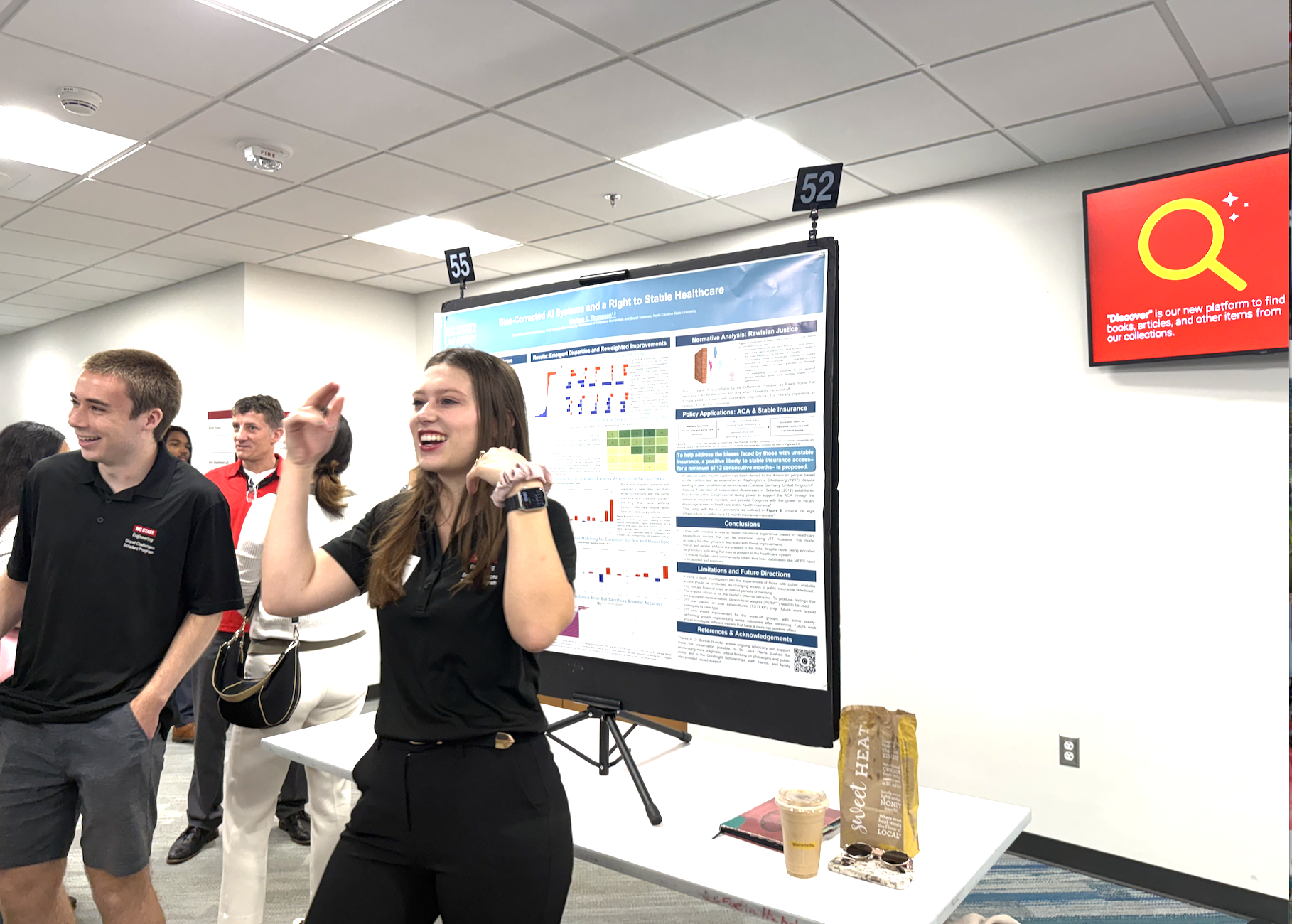
I love sharing what I'm working on. It is
such a privilege and opportunity to be able to pursue higher education, to call myself a researcher, a scientist,
and an engineer. I do nonprofit work, make my research accessible, and do my best to be personable in these expeirences because I know that I am one of the few. I don't
want to jinx myself, but did you know that only 15% of FGLI (first-gen low-income) students who enroll in college actually graduate? Why is that?
I have a lot of STS theories for it, but I think that a lack of representation is a huge part of the issue. So I will continue to wear my identity on my sleeve, engage with a
personality, and make my work accessible. I do what I do for the people, for my community, and to proudly represent my FGLI peers. Sharing science is one of the greatest
privileges I have, and I will continue to do so for as long as I can.
- grad school